

Growth Architecture Book
Building the Operating System Behind a High-Performance Business
By Oksana Pashchenko, Founder of Go:lofty
Most companies don’t fail because they lack ambition.
They fail because they lack a system.
Growth Architecture is a practical book for founders, executives, and growth leaders who are tired of chasing tactics and want to build a business that grows on purpose, not by accident.
Instead of another “growth hacks” collection, this book shows you how to design a Growth Operating System – the loops, data, automation, and operating model that connect strategy to everyday execution.
#GrowthArchitecture
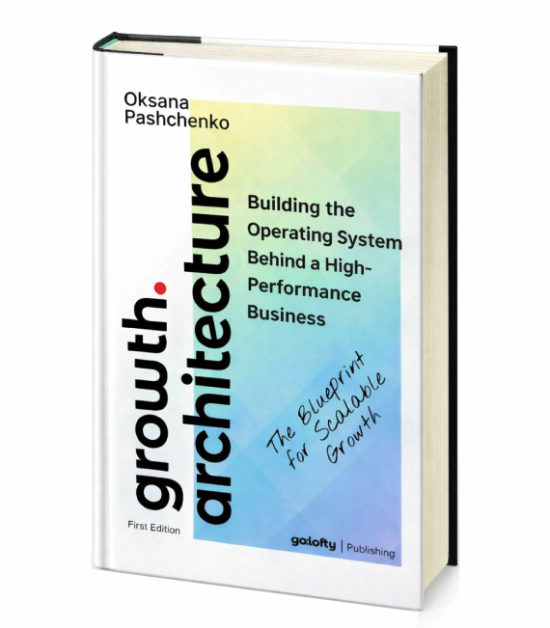
Business book
pages
Available from major booksellers
worldwide
Countries
around the world

About the Author
Oksana Pashchenko is a business strategist and operator who helps founders and senior executives turn strategy into measurable operational results. She works with leadership teams to design and implement end-to-end execution systems across B2B, B2C, DTC, and B2G businesses – from corporate governance and growth strategy to operating models and day-to-day processes.
She is the author of Growth Architecture: Building the Operating System Behind a High-Performance Business, where she codifies how to design scalable growth systems using customer experience, growth loops, data models, automation, and corporate governance. Her experience spans strategy, marketing, digital innovation, eCommerce, and business operations in both startups and global enterprises.
Oksana leads Go:lofty, a strategy and operating-design studio focused on business and go-to-market strategy, as well as AI-enabled growth operating systems.
About the Book
Growth is often treated as a marketing problem or a sales target. In reality, sustainable growth is an architectural property of the whole company.
This book walks you through how to:
- Translate your business strategy into a clear Growth Model, Operations and North Star Metric
- Design growth loops (not just funnels) across acquisition, activation, retention, monetization, and referral…
- Build the data and analytics layer so decisions are driven by signal, not noise
- Use automation and AI to remove repetitive work and protect your team from burnout
- Establish an operating cadence and governance that keeps everyone aligned as you scale
It’s not theory. It’s a field-tested blueprint built from years of work with startups, SaaS businesses, and global enterprises.
About Go:lofty

Go:lofty exists to help companies treat strategy and growth as a system.
The concepts in Growth Architecture are the backbone of our advisory work:
- Growth Models and Growth Operating Blueprints
- Loop-based thinking instead of one-off campaigns
- Integrated data, automation, and AI to support human decision-making
- Operating rhythms and governance that make growth scalable and repeatable
For our clients and community, the book can serve as:
A reference that explains the “why” behind our frameworks.
A shared language to align leadership teams.
A do-it-yourself guide for teams who want to start designing their own Growth Operating System.

Order now
FAQ about the book
1. What is Growth Architecture and why did you write this book?
Growth Architecture is my term for the operating system behind a high-performance business: the combination of strategy, growth loops, data, automation, and operating model that makes growth reliable instead of accidental. I wrote Growth Architecture: Building the Operating System Behind a High-Performance Business after more than seven years working with startups and enterprises that were doing “all the right things” in isolation, but still struggling to grow in a predictable way. The book translates that experience into a practical blueprint any leadership team can use.
2. Who is this growth book for?
This book is for founders, CEOs, Heads of Growth, Product, Marketing, RevOps, and strategy leaders who feel their company is working hard but not growing with the level of clarity and control they want. It’s written for both startups and mature organizations: from Pre-Seed companies designing their first growth model, to scale-ups and enterprises that need to fix operational debt and align multiple teams around one system of growth.
3. How is Growth Architecture different from other growth or strategy books?
Most growth books focus on tactics (channels, hacks, experiments) or on high-level strategy narratives. Growth Architecture sits in the middle: it explains how to connect strategy to execution through a Growth Operating System. The book introduces concrete tools like the Growth Model Canvas, Growth Operating Blueprint, loop-based thinking, a maturity model, and a data & automation architecture that can actually be implemented inside a real company.
4. What is a “Growth Operating System”?
A Growth Operating System is the structural way your company creates, captures, and compounds value. It connects your North Star Metric, growth loops (acquisition, activation, retention, monetization, referral), data and analytics layer, automation stack, and operating rhythm (cadences, rituals, governance). Instead of treating growth as a marketing function, the Growth OS treats it as a cross-functional system that runs through product, marketing, sales, CS, data, and operations.
5. What are “growth loops” and why do they matter more than funnels?
Funnels show a one-time journey from awareness to conversion. Loops show how each outcome fuels the next cycle and makes tomorrow easier than today. In the book, I describe growth loops for acquisition, activation, retention, monetization, and referral, and show how they interact as a system. When you design loops, you stop relying on one-off campaigns and start building compounding engines that continue to work even when budgets or attention shift.
6. How does the book connect strategy with data, analytics, and AI?
A big part of the book is dedicated to the data & analytics layer and how it supports the Growth Operating System. I explain how to build a loop-first data model, define events, create an identity layer, and design dashboards that reflect real growth mechanics. From there, I show how automation and AI can be layered on top to reduce manual work, protect teams from burnout, and turn data into timely, actionable decisions rather than noise.
7. Can this framework work for both startups and large enterprises?
Yes, and that’s one of the core design decisions behind Growth Architecture. The logic of the Growth Operating System is stable across stages, but its configuration changes. In the book, I show how the same principles apply to low-touch B2C products, hybrid B2B SaaS, high-touch enterprise platforms, and regulated industries like pharma and healthcare. The tools are adaptable whether you’re a founder with your first product or a C-level executive in a global organization.
8. How does this book help with strategy execution, not just strategy design?
The book treats growth as the operating expression of strategy. It doesn’t stop at “what we want to achieve” but goes into “how we will run the system that achieves it.” I walk through operating cadences, leadership rituals, ownership maps, automation architecture, and a Growth Operating Maturity Model. That helps leadership teams move from slideware and OKRs to a concrete way of working that translates strategic intent into day-to-day behavior.
9. Who is Oksana Pashchenko and what experience is this based on?
I’m a business strategist and operator working with founders, boards, and senior executives to turn strategy into measurable operational results. My background spans startups and large enterprises in B2B, B2C, DTC, and B2G, with a focus on growth operating models, digital and MarTech ecosystems, and AI-enabled workflows. Growth Architecture is a synthesis of 20+ years in business, seven-plus years of research and hands-on work with companies across different industries and maturity levels.
10. How should a team use this book in practice?
You can read it end-to-end for a full view of the Growth Operating System, then come back to specific chapters when you’re ready to design your Growth Model, audit your loops, or build your data and automation layers. Many teams will use it as a shared reference for workshops or strategy offsites, mapping their own Growth Model Canvas and Operating Blueprint together. I also recommend pairing the main book with the upcoming Growth Architecture Workbook, which will include guided exercises, canvases, and checklists tailored to your specific business.
More from the author
-
- Posted by Go:lofty Team
