


Market sizing is one of the most misunderstood yet consequential activities in business strategy. When done rigorously, it provides strategic clarity, investment discipline, and execution realism. When done superficially, it becomes a storytelling exercise disconnected from operational reality.
The TAM, SAM, SOM framework originated in strategic management and industrial economics as a way to distinguish between theoretical market potential and realistically capturable demand. Over time, it has become a cornerstone of corporate strategy, venture investing, and go-to-market planning.
This article explains TAM, SAM, and SOM from both an academic and practical perspective, and shows how to calculate them using concrete examples. More importantly, it demonstrates how the framework should be embedded into the end-to-end strategy process, rather than treated as a standalone spreadsheet exercise.
TAM, SAM, and SOM as Strategic Concepts (Not Just Numbers)
In strategy literature, markets are rarely treated as monolithic. Scholars such as Michael Porter and Roger Martin emphasize that competitive advantage depends not on market size alone, but on where and how a firm competes within that market. TAM, SAM, and SOM operationalize this idea.
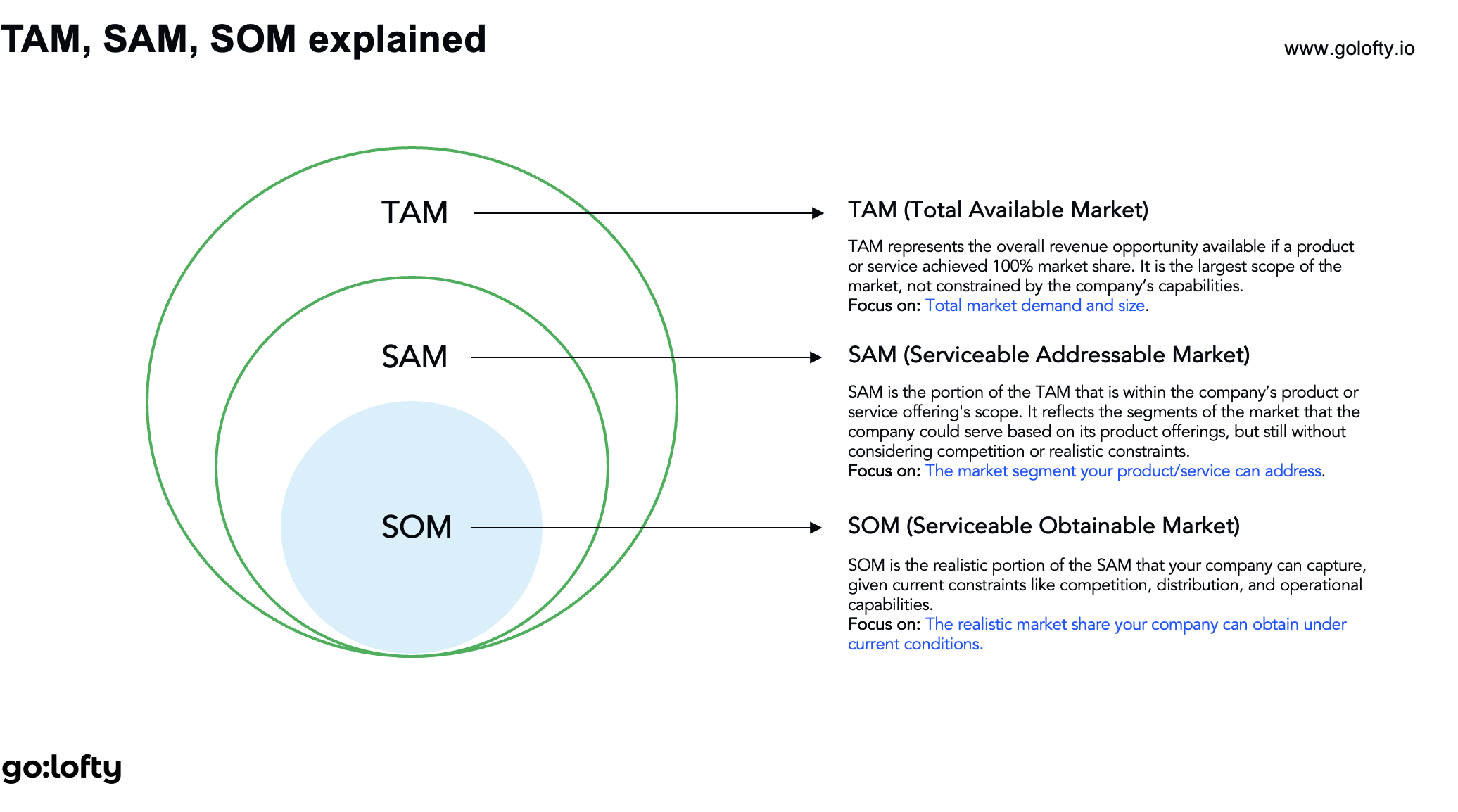
Total Available Market (TAM) represents the maximum economic demand for a category of product or service, assuming no competitive, regulatory, geographic, or capability constraints. TAM is a macro-level construct. It answers the question: If this problem were solved universally, how large would the demand be?
Serviceable Addressable Market (SAM) narrows that demand to the portion aligned with a firm’s business model, offering, and strategic scope. SAM introduces realism by incorporating product characteristics, customer segments, and contextual constraints.
Serviceable Obtainable Market (SOM) further constrains the analysis by introducing competition and execution capacity. SOM reflects the share of SAM a firm can plausibly capture over a defined time horizon.
From an academic perspective, TAM relates to industry structure, SAM to strategic positioning, and SOM to competitive dynamics and firm capabilities.
Two Canonical Methods to Calculate Market Size
In both academic research and professional practice, market size is calculated using two primary approaches: top-down and bottom-up. High-quality strategy work typically triangulates both.
The Top-Down Method
Top-down sizing starts with a broad, externally validated market figure and progressively narrows it using segmentation logic.
For example, consider a company building a B2B SaaS platform for pharmaceutical omnichannel marketing.
Industry reports estimate the global pharma commercial software market at approximately $40 billion annually. This represents the TAM.
If the company only serves large pharma enterprises and excludes CROs, generics, and emerging markets, the addressable portion might be $15 billion. That figure becomes the SAM.
If competitive analysis and go-to-market capacity suggest the company could capture 3% of that SAM over five years, the SOM would be $450 million.
Top-down methods are useful for strategic vision, investor communication, and portfolio planning, but they often overstate realism if not validated operationally.
The Bottom-Up Method (Preferred for Execution)
Bottom-up sizing builds the market from unit economics and customer behavior. It is considered more rigorous in academic and investor contexts because it is grounded in observable reality.
Let’s take a practical example.
Assume a company sells an enterprise SaaS product at an average annual contract value (ACV) of $50,000.
Market research identifies 20,000 companies globally that match the ideal customer profile (ICP).
This produces a TAM of:
20,000 × $50,000 = $1 billion
Now introduce strategic constraints.
If the company only serves North America and Europe, covering roughly 60% of these customers, the SAM becomes:
$1 billion × 60% = $600 million
Finally, assess execution capacity.
If the sales organization can realistically close 300 customers over five years, the SOM is:
300 × $50,000 = $15 million annual revenue
This SOM figure is far smaller than TAM, but it is strategically actionable. It directly informs hiring plans, sales quotas, marketing budgets, and cash-flow projections.
From a strategic standpoint, bottom-up SOM is the most important number.
How TAM, SAM, and SOM Map to the Strategy Lifecycle
The true value of the framework emerges when it is linked to different stages of strategy design and execution.
TAM and Strategic Aspiration
TAM belongs to the vision and ambition phase of strategy. It helps leaders decide whether an opportunity justifies long-term investment, platform development, or organizational transformation.
In academic terms, TAM supports strategic intent rather than tactical planning. It answers “Is this market worth playing in?” not “How much will we sell next year?”
SAM and Strategic Choice
SAM sits at the core of strategy formulation. It forces segmentation decisions: which customers matter, which use cases to prioritize, which geographies to enter first.
This aligns with Porter’s notion of strategy as choice and trade-off. Defining SAM is less about inclusion and more about deliberate exclusion.
SOM and Strategy Execution
SOM belongs squarely to execution and operating planning. It translates strategy into numbers that can be owned, measured, and delivered.
In practice, SOM should align with:
sales capacity models,
marketing funnel assumptions,
customer acquisition cost constraints,
and operational scalability.
If SOM cannot be operationalized into targets and KPIs, it is not credible.
A Common Academic Pitfall: Confusing Market Size with Market Power
One frequent misconception is that large TAM automatically implies strategic attractiveness. Economic theory warns against this assumption.
Large markets often attract intense competition, commoditization, and margin erosion. Smaller SAMs, when aligned with strong differentiation and switching costs, may yield superior returns.
Thus, TAM should never be evaluated in isolation. It must be interpreted alongside:
competitive intensity,
differentiation potential,
regulatory barriers,
and cost structure.
SOM, not TAM, is where economic value is actually realized.
How Market Size Evolves Over Time
Another advanced insight often missed in basic explanations is that TAM, SAM, and SOM are dynamic.
As companies innovate, expand geographically, or shift business models, their SAM and SOM can grow without the TAM changing. Conversely, market disruption can shrink SAM even when TAM appears stable.
Strategically mature organizations revisit market sizing annually, treating it as a strategic learning mechanism, not a static forecast.
Final Strategic Perspective
TAM, SAM, and SOM are not merely financial metrics. They are strategic lenses that help leaders align ambition with reality.
TAM defines the scale of opportunity.
SAM defines where strategy is focused.
SOM defines what execution can deliver.
When integrated into an end-to-end strategy process, the framework creates discipline, credibility, and strategic clarity. When used superficially, it creates illusion.
At Go:lofty, we help organizations apply TAM, SAM, and SOM as part of a broader Strategy as a Function approach—connecting market intelligence, strategic choice, and execution planning into a single coherent system.
FAQ
1. What is the difference between TAM, SAM, and SOM?
TAM (Total Available Market) represents the total theoretical demand for a product or service if a company captured 100% of the market. SAM (Serviceable Addressable Market) narrows this to the portion of the market that aligns with the company’s product, business model, and target segments. SOM (Serviceable Obtainable Market) represents the realistic share of SAM that the company can capture given competition, resources, and execution capacity. Together, they distinguish between market potential, strategic focus, and executable reality.
2. Why is TAM important if it is not realistically attainable?
TAM is important because it frames strategic ambition, not execution targets. It helps leaders and investors assess whether a market is structurally large enough to justify long-term investment, platform development, or organizational scaling. TAM informs vision and strategic direction, even though it should never be used as a revenue forecast.
3. How is SAM different from TAM in strategic decision-making?
SAM translates ambition into focus. While TAM defines how large a market could be, SAM defines where the company will actually compete based on product fit, customer needs, geographic reach, and regulatory constraints. Strategic trade-offs—such as which segments to prioritize or which markets to exclude—are made at the SAM level.
4. How should SOM be calculated in practice?
SOM should be calculated bottom-up using execution realities. This typically involves estimating the number of customers the company can realistically acquire over a defined period and multiplying that by average contract value or revenue per customer. SOM must reflect sales capacity, competitive pressure, customer acquisition costs, and operational scalability. If SOM cannot be operationalized into sales targets and KPIs, it is not credible.
5. Which market sizing method is better: top-down or bottom-up?
Bottom-up market sizing is generally more reliable for strategy execution because it is grounded in observable data such as pricing, customer counts, and sales capacity. Top-down sizing is useful for vision-setting and external communication but should always be validated against bottom-up assumptions. High-quality strategy work triangulates both methods.
6. How do investors evaluate TAM, SAM, and SOM?
Investors look for coherence and credibility, not inflated numbers. A large TAM signals ambition, but investors focus heavily on SAM clarity and SOM realism. They assess whether the company understands its target customer, competitive dynamics, and path to capturing meaningful market share. A well-reasoned SOM often carries more weight than an impressive TAM figure.
7. How often should TAM, SAM, and SOM be updated?
Market sizing should be revisited regularly, typically on an annual basis or when major strategic changes occur. As products evolve, geographies expand, or go-to-market models change, SAM and SOM often shift significantly. Treating TAM, SAM, and SOM as dynamic strategic inputs rather than static numbers improves long-term decision quality.
8. Can TAM, SAM, and SOM change over time without market growth?
Yes. Even if the overall market (TAM) remains stable, a company’s SAM can expand through product innovation, new use cases, or geographic expansion. Similarly, SOM can grow as capabilities, brand strength, and distribution improve. Strategic growth often comes from expanding addressability and obtainability, not just market size.
9. What are the most common mistakes companies make with TAM, SAM, and SOM?
Common mistakes include overestimating TAM, defining SAM too broadly, setting SOM targets disconnected from execution capacity, and using the framework only for fundraising rather than internal strategy. Another frequent error is ignoring competitive dynamics when estimating SOM. These mistakes lead to unrealistic plans and weak execution.
10. How does TAM, SAM, and SOM fit into an end-to-end strategy process?
TAM informs strategic ambition and long-term vision. SAM shapes strategic choices around positioning, segmentation, and focus. SOM drives execution by setting realistic targets for sales, marketing, and operations. When integrated into the strategy lifecycle, the framework ensures alignment between market opportunity, strategic intent, and operational delivery.
Watch the video
More to read

Click here
“You already have the talent. This is about giving that talent a better operating model to run on.”